
The 1996 Seattle Mariners: Part 4
The Mariners limp into June and find more injuries. Amidst All-Star voting and trade rumors, the team fights to stay the course.
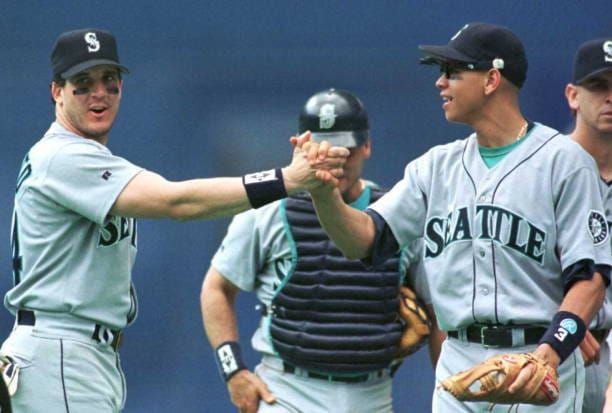
The Mariners came into the month of June having lost their two best starting pitchers, Randy Johnson and Chris Bosio. They were significant losses and the rest of the pitching staff was feeling the strain. As they played toward the halfway point of the season, the pitching shuttle between Tacoma and Seattle continued, more injuries popped up, and the offense clipped along at an historic pace.
June 4 - Mariners 10, Cleveland 7
The Mariners pulled off their 15th comeback win of the season, scoring four runs in the top of the ninth inning against Cleveland’s nearly untouchable closer Jose Mesa. It was the first time Cleveland had blown a lead in the ninth inning since August 2, 1994.
June 5 - Cleveland 13, Mariners 5
Matt Wagner made his major league debut, going six innings. He left with the game tied and the bullpen couldn’t hold it. Bob Milacki, Solomon Torres, Mike Jackson, and Paul Menhart allowed a combined 10 Cleveland runs to score.
June 6 - Mariners 5, Cleveland 2
Bob Wells made his first start and only allowed two runs over six innings. Ken Griffey Jr. robbed Manny Ramirez of a home run and Dan Wilson drove in three runs.
June 7 - Royals 9, Mariners 5
Bob Wolcott only lasted three plus innings while the Mariners lost focus when Russ Davis left the game in the fourth inning after breaking his leg chasing down a foul ball.
June 8 - Royals 12, Mariners 8
Bob Milacki started and only made it three innings. The offense did its best, with 17 hits including four hits and three RBI for Joey Cora, and three hits and three RBI for Darren Bragg.
June 9 - Mariners 3, Royals 2
Dan Wilson slugged the Mariners’ 100th home run of the season and contributed two singles as the Mariners snapped their losing streak. Sterling Hitchcock went six innings and only allowed one run.
June 10 - Twins 13, Mariners 6
Nine combined home runs were hit in the game, but the Twins had the preponderance with five and took the win. Matt Wagner allowed six runs in his six innings. Rafael Carmona and Blas Minor allowed seven more.
Cincinnati Reds CEO Marge Schott was forced to give up daily operations after her latest offensive comments.
The Colorado Avalanche won the Stanley Cup Finals in four games over the Florida Panthers.
June 11 - Mariners 18, Twins 8
Bob Wells started and gave up a season-high five runs, but the Mariners pulled out a slugfest of a win as former University of Minnesota Golden Gopher Dan Wilson became just the 10th player in Mariners history to have five hits in a game. Joey Cora and Alex Rodriguez were right at his heels with four hits each.
Kansas Senator Bob Dole resigned from the US Senate to run for president.
June 12 - Mariners 5, Twins 3
Bob Wolcott bounced back and had a good start. Alex Rodriguez and Dan Wilson each extended their hitting streaks to 10 games while Ken Griffey Jr. set a club record by making 11 putouts. Rodriguez and Griffey also each hit home runs and the Mariners wrapped up the road trip with a win.
June began with a nod toward the future. With their first selection in the amateur draft, the Mariners plucked 17-year-old high school pitcher Gil Meche out of Lafayette, Lousiana. Meche was a low-drama pick; he signed with the Mariners about a week later and headed to Arizona to start his professional career with the rookie league M’s.1
The major league Mariners called Matt Wagner up to the rotation. When he made his major league debut on June 5th, he became the eighth starting pitcher used by the Mariners, just a skosh over two months into the season. He’d start 14 games and appear once in relief for the Mariners in 1996, the entirety of his major league career. A native of Cedar Falls, Iowa, he was initially drafted out of high school by Atlanta, but opted to take a scholarship at the University of Arkansas. There he suffered injuries to his shoulder, and a doctor told him he was unlikely to pitch again.
He went home to finish his education at Iowa State University, where he was invited to hang out with the baseball team. A coach noticed the ball was popping out of his hand while he casually played catch.2 Turns out, the rest from throwing allowed the tear in his shoulder to scar over perfectly. He began pitching again, and the Mariners selected him in the third round of the 1994 draft.
Wagner made his debut against Cleveland, one of the top offenses in 1996 and the defending American League champions. It was quite a feat for a player once told he would never pitch again. The shoulder did come back to hinder him later, but in his starts for the Mariners, he delivered what they needed, a handful of innings and the score kept close.
On the heels of Wagner’s debut, Bob Wells made his first start since moving out of the bullpen. He was exactly what Lou Piniella hoped he would be, only allowing two runs over six innings. In June he provided the Mariners with the stability they desperately needed in their chaotic rotation, going a perfect 5-0 with a 4.91 ERA. It was enough for Seattle scribes to call for his inclusion on the American League All-Star team.3 The All-Star team may have been a stretch, but with the trouble the rotation had had, Wells certainly looked like an All-Star on the mound.
Despite those boosts, the Mariners still needed pitching help. The bullpen, under the weight of so many innings, was faltering. This was the case across baseball though, and when veteran reliever Greg Swindell became a free agent after clearing waivers, the Mariners were one of 12 teams in pursuit. The Mariners needed a guy like Swindell, a veteran reliever who could get the job done at a discounted price. “We’re not in a position to add salary,” General Manager Woody Woodward said flatly.4
Swindell opted to sign with Cleveland, and Woodward doggedly pursed trade opportunities. Blas Minor, a middle reliever with four years of major league experience, was exchanged by the Mets for a single-A infielder. To make room, the Mariners designed Bob Milacki for assignment, and for good measure, they swapped Paul Menhart for Edwin Hurtado in Tacoma. The pitching carousel kept spinning right ‘round.
As if the pitching struggles weren’t enough, the Mariners could not avoid the injury plague. Alex Diaz, the outfielder who had filled in so ably for Ken Griffey Jr. during his absence in 1995, was placed on the 60-day disabled list with bone spurs. Jay Buhner was dealing with nagging soreness in one of his knees and a sore thumb he sprained sliding into third base. He missed a week after the thumb injury, and dealt with lingering pain for some time after.
Then, in Kansas City another injury threatened to know their season off course. Third baseman Russ Davis was chasing a foul pop up down the left field line. Trying to make the catch, he slid toward the fence where his left foot was caught under the protective padding and “the bone just snapped."5
He left the field on a stretcher, suffering a mid-shaft fibula fracture and a severely sprained ankle. It was almost identical to the fracture suffered by pitcher Tim Davis, making it a rough season to be a Davis for the Mariners. The initial timeline for his return was 6-8 weeks. However, the extent of the soft tissue damage meant he’d miss the rest of the season.
Even with all the injuries the Mariners had suffered, the offense was producing at historic levels. No team in baseball had more home runs than the Mariners. They were on pace to reach 279 as a club, blowing past the major league record of 240. Buhner reached 20 home runs in his 54th game of the season, the second fastest pace ever for Seattle, behind only Ken Griffey Jr., who reached 20 home runs in 42 games in 1994. Dan Wilson was having a career year, and was the only catcher in the American League batting .300 with 10 home runs and 40 RBI. The only other catcher in all of MLB hitting those marks was the Los Angeles Dodgers’ Mike Piazza.
While Roger Maris’ home run record was a shining beacon of slugging achievement, Edgar Martinez was quietly pursuing a record that was just as impressive, the doubles record of 68 set by Boston’s Earl Webb in 1931. When the first half of the season wrapped for the All-Star Break, Edgar had hit 42 doubles and was on pace to obliterate Webb’s record with 80.
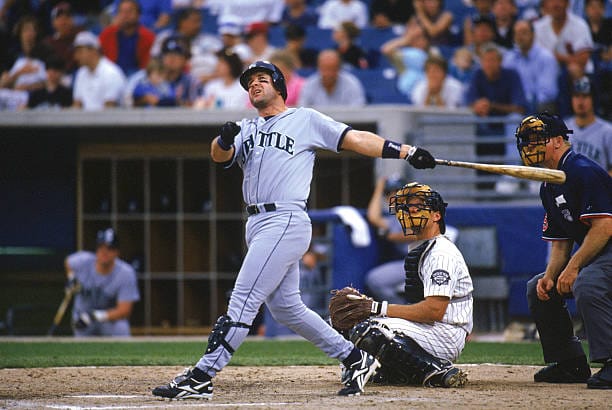
All together the Mariner trio of Griffey, Martinez, and Buhner were putting up historically huge numbers. They were drawing comparisons to the fearsome 1927 New York Yankee trio of Babe Ruth, Lou Gehrig, and Tony Lazzeri, all of whom hit over .300 and put together 125 home runs and 441 RBI. The Mariners trio was on pace for 149 home runs and 445 RBI.6
It’s just that, in addition to hitting more home runs than any other team in baseball, the pitching had also given up more home runs than any other team in baseball, with the exception of the Detroit Tigers.
So while the offense could overpower opposing pitchers and put huge numbers on the scoreboard, defeated was often wrested from the jaws of victory with the swings of opposing bats.
June 14 - White Sox 4, Mariners 1
Sterling Hitchcock went eight innings, the first Mariners starter to go that deep since Randy Johnson worked eight on April 16th. The sole run was scored when Dan Wilson drove in Edgar Martinez on an RBI groundout.
June 15 - Mariners 8, White Sox 6, 12 innings
Brian Hunter hit a game-winning two-run home run in the bottom of the 12th inning after Mariners and White Sox closers, Norm Charlton and Roberto Hernandez, traded blown saves in the ninth.
June 16 - Mariners 7, White Sox 6
Bob Wells had a rough start, allowing all six White Sox runs, including a three-run home run to Ozzie Guillen, only his second of the year. But the Mariners offense bailed him out with Edgar Martinez hitting two doubles. Mike Jackson pitched five outs, earning his third save of the year.
The Chicago Bulls, led by former Chicago White Sox prospect Michael Jordan, defeat the Seattle SuperSonics to win the NBA Finals
June 18 - Blue Jays 11, Mariners 3
Juan Guzman reprised his role as Mariner nemesis, beating them for the seventh time in his career. It was a frustrating offensive game for the Mariners. They sent nine batters to the plate in the first inning, and only managed to bring in three runs. Wolcott had a rough game, falling behind 4-0 in the top of the first inning.
June 19 - Blue Jays 9, Mariners 2
Tim Harikkala joined the starting rotation and was welcomed back to the big leagues by six Blue Jays runs in 4 1/3 innings. But that was the least of the Mariners worries; Ken Griffey Jr. broke his hamate bone and the team faced a stretch without him for the second year in a row.
The Mariners began a quick five-game home stand with the Chicago White Sox while their Seattle sports cousins, the SuperSonics were playing the Chicago Bulls in the NBA Finals. The Sonics dropped the first three games to the Michal Jordan-era Bulls, then pulled off a victory in Game Four. It was an echo of the Mariners in 1995, so as the Mariners played the White Sox, the Kingdome crowd could be forgiven for having more interest in the basketball game across town.
Highlights and the score were shared on the Kingdome screen. Sterling Hitchcock noted after the game that he heard loud cheers as he was throwing his warm up pitches before the fifth inning. “I figured it had something to do with the Sonics,” he joked, “The warmup pitches weren’t that good."7 That night, the Sonics took Game Five. The Sonics ultimately lost two nights later in Chicago, as the Mariners won the series with the White Sox.
After the White Sox, the Mariners faced the Blue Jays. The team felt a boost of energy when Jay Buhner returned to the lineup after missing a week with his sore thumb. That energy deflated in the final game of the home stand, when Ken Griffey Jr. felt a pop, then a sharp pain as he hit a foul ball. Griffey shook his hand, grimacing in pain, and everyone had flashbacks to 13 months before, when he broke his left wrist in two places.
Luckily, this injury wasn’t as devastating. On the swing, Griffey broke the hamate bone in his right wrist. He was only expected to miss three to five weeks, a much better turnaround than the two months he missed the previous year. After the unrelenting string of injuries, only losing Randy Johnson hurt as much as losing Griffey.
The Mariners had an entire flight to Chicago to mope over the latest injury. Perhaps there was hope ahead in the Windy City; the pitching staff was getting ready to welcome back one of their injured brethren.
June 20 - Mariners 8, White Sox 5
Sterling Hitchcock pitched into the seventh inning. The offensive highlight for the Mariners was the second inning, when they had six hits, five singles, and four Mariners went from first to third on hits and scored four runs, a rare display of small ball from the erstwhile sluggers.
June 21 - Mariners 12, White Sox 2
Mariners starter Matt Wagner earned his first major league win, going eight innings. Bobby Ayala pitched a 1-2-3 ninth and struck out two in his return. Edgar Martinez, Alex Rodriguez, and Brian Hunter each hit a home run.
June 22 - Mariners 4, White Sox 2
The Mariners won their third game in a row for the first time since mid-April and remained undefeated since losing Ken Griffey Jr. Bob Wells threw a career-high 110 pitches and remained undefeated since joining the rotation. The bullpen, led by Bobby Ayala looked fantastic over 3 1/3 innings.
June 23 - White Sox 7, Mariners 6, 10 innings
The White Sox broke their eight-game losing streak when Ray Durham slapped a double off Lee Guetterman to score two runs. Alex Rodriguez and Paul Sorrento hit home runs for the Mariners.
Nintendo released the Nintendo 64 in Japan.
June 25 - Blue Jays 8, Mariners 7
For the second game in a row, the Mariners were walked off. This time, Jacob Brumfield of the Blue Jays hit a two-run home run off a high and outside Norm Charlton fastball.
June 26 - Blue Jays 6, Mariners 5
The Mariners lost their third straight game in late innings. This time it was Bobby Ayala who took the loss, allowing a two-run double to Jacob Brumfield in the bottom of the seventh.
Kobe Bryant was the first guard ever drafted directly out of high school and into the NBA.
June 27 - Mariners 9, Blue Jays 1
The Mariners won decisively on the final game of the road trip. Bob Wells pitched into the seventh inning and only allowed one run. The bullpen held the Blue Jays scoreless. Paul Sorrento hit his 14th home run and drove in four.
Edgar Martinez found himself in a slump as June wore on. With the injuries to Jay Buhner behind him in the lineup, and to Ken Griffey Jr. in front of him, he was without their potent protection. Over the course of the road trip, he went 2-for-25 and finished without a hit in five straight games. Buhner, too, would see his offense stymied in June. Whether it was the lingering pain in his thumb or simply regression to the mean, his numbers dropped in June and would continue to drop before a resurgence in September.
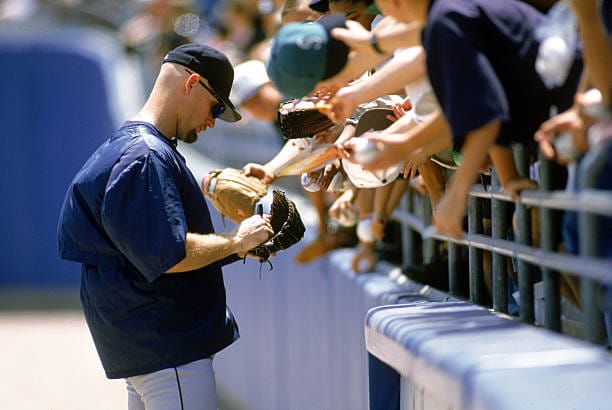
So, perhaps the 1927 Yankees the 1996 Mariners were not, but they were still an immensely talented offensive team, slumps and all. In fact, they were undoubtedly one of the best at a time when offense felt like it was increasing exponentially. And nothing gets the tongues of baseball old timers, sports pundits, and sports radio callers wagging quite like an increase in offense.
Bill Reynolds laid out the complaints in the Seattle Times. It was representative of the complaints printed in newspapers across the country and aired on sports radio. He complained that the baseball he was seeing was
not the same game it once was. Not even close. Bunt the guy to second base? Move the runner over? Play solid, fundamental baseball? Yeah, right. Instead, it’s play for the big inning every inning…It’s both the legacy of the strike and the perception that baseball is too slow for the clicker culture we live in.8
If that refrain sounds familiar, it’s because it’s the same complaint that has been passed down through baseball, generation to generation, each time there has been a change in the game. The refrain that baseball is trying to appeal to non-baseball fans, that baseball’s records are sacred, that the modern games cheapens history, that this generation of players does not care about the game and its traditions, and that kids these days just won't pay attention.
Regardless of whether the increase in offense was good or bad, or a secret third thing—simply the way the winds were blowing—baseball was changing, as it had, significantly, over the course of its history. The equal and opposite affect was that pitching was down, and pitching was a problem for almost every single team. The struggles of the Mariner pitching staff—starters unable to go deep into games and shaky relief performances—were far from unique to them as a team, though the Mariners did veer toward the extremes, but more as a difference in degree than kind.
Most of the frustration in the rotation was with Bob Wolcott and Sterling Hitchcock. Each pitcher showed flashes of perfectly competent, even good, pitching. Each had good starts that hinted at their potential. But neither had luck at building on their starts, and seemed to alternate promising starts, with brutally bad starts.
Piniella consistently told reporters that he needed his starters to go deeper into games. In mid-June the Mariners set a franchise record for the longest streak without a complete game.9 By the end of the month they were one of only two MLB teams (Oakland being the other) without a complete game from a starting pitcher.
Though Piniella was well acquainted with the modern version of baseball, he wasn’t immune to breaking out the “back in my day” routine:
When I played, pitchers would go eight innings a game. There was no pitch counts, they were pitching on four days rest…Today, six innings is acceptable for a starter. In two years, that might be four innings. Maybe the secret is to let these kids take their lumps, just sit and watch them.10
Later on, Piniella “paced his office in his underwear, thinking more thoughts on pitching”:
We’re throwing too many pitches early in games with no purpose, we’re using too many pitches to get an out, trying to be perfect. That should be learned before kids get to this level…I think we have to start early in the minors and teach some of our kids that pitching deep in a game is a habit they need to acquire…It’s something we’re not doing.11
Piniella’s comments were at odds with the standards in the Mariners minor league system. The organization set a pitch count of 100 in April and May and raised it to 115 pitches in June. Bob Wolcott was among the Mariners pitchers who endorsed pitching longer in the minor leagues. “It’s much better to be allowed to build up your arm if you can. There’s no reason you can’t go up to 130, maybe even 140 pitches,” he said.12
Regardless of the right or wrong, or good or bad of it, baseball was undeniably changing. And the Mariners were undeniably suffering from those growing pains and the clash between an old-school manager and a minor league system with new ideas.
*
Tim Harikkala was called up to start for the Mariners to wrap up the home stand against Toronto on June 19. It was an inauspicious start; 4 1/3 innings that yielded six runs on four hits. It was his only appearance in 1996, and his last in the major leagues until he resurfaced for seven games with Boston in 1999. Following that game, Harikkala was sent back to Tacoma to make room on the roster for the return of Bobby Ayala.
Ayala was activated in Chicago, the scene of his mysterious injury in April. He returned with a vengeance and a higher velocity on his fastball, 94 mph versus about 92 mph in April. Piniella was thrilled to have him back. “I can use him against right-handed batters with his fastball and slider, and against lefties his split-finger forkball. I can’t say enough about how good it is to have him back and contributing."13
Though his hand had healed, Ayala was still upset at the media reaction back in April. After initially brushing off reporters with a brusque, “Don’t ask me nothing”,14 he gave a longer statement a couple days later:
I’ve been through so much and some things were written and said that hurt when I went through that situation here before. I’d just like to pitch for a while and let it stand at that, and maybe we can talk sometime down the road.15
Ayala looked like he was back to his 1994 and early 1995 form between his return and the All-Star break. But that time down the road when he’d speak to the media again? It never came.
*
On June 21 the Mariners acquired pitcher Rusty Meacham from Kansas City for a minor league outfielder. Though their main need was pitching, the Mariners were also pursuing offensive help. There’d been a few rumors that they may go after Darryl Strawberry, then playing for the St. Paul Saints in the Independent Northern League.16 The Mariners said they weren’t interested due to his history. They were, however, interested in Mark Whiten who was released by Philadelphia in June. He wasn’t interested in the Mariners though; he wanted to stay in the National League and play right field, not left field, where he’d play in Seattle.
June 28 - Mariners 19, Rangers 8
The Mariners had 22 hits against the AL West leaders. Luis Sojo led the way with five singles and Joey Cora showed off with two triples and two singles. Edgar broke out of his slump with a two-run home run.
The Nutty Professor was released in theaters.
June 29 - Rangers 9, Mariners 5
Rusty Meacham made his first start and pitched into the seventh inning, giving up six runs. Mike Jackson gave up the other three runs in relief. The fans in the Kingdome set a record for the most people participating in the “Macarena” dance.
June 30 - Mariners 4, Rangers 3
The Mariners took two out of three, and the final game of the series from the Rangers, but still lag behind them in the standings. Edgar Martinez hit two doubles.
July 1 - Athletics 6, Mariners 4
The Mariners offense struggled against the last-place A’s, loading the bases in the first and third innings, and only getting two total runs out of it. Joey Cora showed up with four hits. Matt Wagner struggled with five unintentional walks leading to three Oakland runs.
July 2 - Athletics 11, Mariners 6
Jason Giambi had a career-high five hits and Terry Steinbach hit two home runs against Mariners pitching. For the Mariners, Brian Hunter tied a career-high going 4-for-4. The team had runners on base in all but the first inning, but couldn’t hold on to the lead.
July 3 - Mariners 4, Athletics 3
Bob Wolcott pitched into the eighth inning and reliever Bobby Ayala earned his first win of the year. The Mariners won on Edgar’s game-winning ninth inning RBI double.
Independence Day was released in theaters.
Going into 1996 the best offensive season by a Mariners shortstop was the 1982 campaign from Todd Cruz, when he hit 16 home runs and drove in 57 RBI. At the end of June, Alex Rodriguez was one home run away from tying those marks. He was on pace to hit 32 home runs and drive in 119 runs with a .340 batting average. Those were mind boggling numbers for a player in their first full season, much less a shortstop.
“A real temptation arises,” Dave Bolling wrote in the News Tribune, “to hitch up the superlatives and prematurely drive this guy away on the Cooperstown express."17 It was hard not to.
But Rodriguez, when asked about his offensive production, deflected. “I don’t really care what I do offensively. I know the way I’m going to help this team win games is with my defense. Anything I do offensively is just extra."18 It’s the sort of statement that rings false now, having been through the drama-rama that consumed his major league career after his stint in Seattle. But in 1996, Seattle sportswriters gushed about his maturity and his level headedness. It set a standard of perfection would have been difficult for the most polished player to maintain.
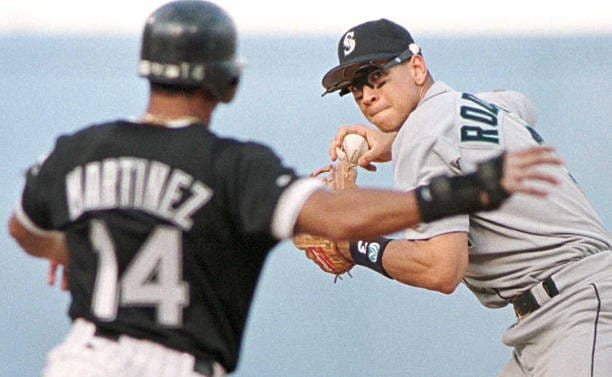
His leaderboard stats and mature comments belied that he was still a kid, and still learning to play at the major league level. He shared that in Chicago he let catcher Chad Kreuter get into his head. While Rodriguez was batting, Kreuter “was telling me what a good young player I was, asking me if he could have one of my bats. Talking, talking. And I made the mistake of talking back, asking him to be quiet, telling him we could talk all he wanted after the game."19
Kreuter continued chattering behind the plate, and Rodriguez later blamed a strikeout and ground out on the distraction. He was showing he could physically play in the major leagues with the best of them. But it was the mental challenges, like a chatty catcher, that were part of his big league learning curve.
Still, the week of the All-Star break it was Alex Rodriguez, not Chad Kreuter, on the cover of Sports Illustrated. The cover story painted a picture of him not unlike that of the Seattle writers:
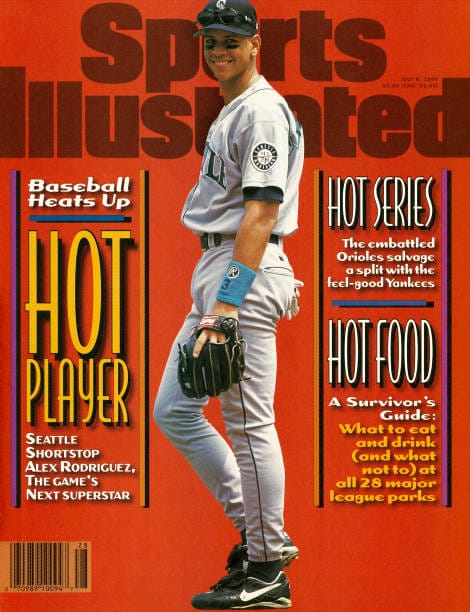
In the off-season he lives with his mother, Lourdes Navarro, and shares a bedroom with his best friend, a three-year-old German shepherd named Ripper. He plays golf each morning and hoops each evening, and by 10 p.m. he is nestled in bed with his Nintendo control pad. He makes Roy Hobbs look like John Kruk, and he makes you wonder if you're missing something: A guy this sweet has to be hiding some cavities.
On July 27, Alex Rodriguez will turn 21, making him old enough to have a beer with his Seattle Mariners teammates. He says he's not interested. "Can't stand the taste," he says. Rodriguez has always felt more at home among milk drinkers.
He grew up in the Miami suburb of Kendall with a poster of Cal Ripken Jr. over his bed and number 3 on the back of his baseball uniform, tribute to another of his idols, former Atlanta Braves star Dale Murphy. "My mom always said, 'I don't care if you turn out to be a terrible ballplayer, I just want you to be a good person," says Rodriguez. "That's the most important thing to me. Like Cal or Dale Murphy, I want people to look at me and say, 'He's a good person.'"20
Of course it’s hard to say with any certainty how sincere any of this Leave-It-To-Beaver-esque act was; it’s such a contrast to his later persona of “A-Rod”. But it’s worth remembering that once he was a kid who was simply happy to be in the major leagues. For all the bitterness that came later between Mariners fans and Alex Rodriguez, we got the brightest years of his career.
*
The Mariners picked up a game on Texas, cutting their lead to five games, after taking two of three from them in Seattle. The Mariners then dropped two of three to the last place Oakland Athletics, as they were wont to do.
Randy Johnson was set to throw off the mound in a few days, a welcome development. “We’re facing a double-edged sword,” Piniella said of the Mariners’ situation. They couldn’t fall any further behind in the division if they realistically wanted a shot to win. Runs like they had in 1995 didn’t happen every year. “We have to stay close until we get him back,” Piniella said of Johnson, “and I’m not sure we can stay close without him."21
July 4 - Mariners 9, Rangers 5
The Mariners won in the top of the ninth inning when they scored five runs, four coming on Paul Sorrento’s grand slam. Rusty Meacham had a serviceable start, going 6 1/2 innings. Bobby Ayala pitched a 1-2-3 bottom of the ninth.
Hotmail launched its free email service.
July 5 - Mariners 6, Rangers 3
Sterling Hitchcock came within two outs of a complete game and had a career-high nine strikeouts. Darren Bragg and Jay Buhner hit home runs, while Edgar Martinez, Rich Amaral, and Paul Sorrento each had three hits.
The first successfully cloned mammal, Dolly the Sheep, was born. She would not be announced to the public until February 1997.
July 6 - Mariners 9, Rangers 5
Alex Rodriguez hit his third grand slam of the season, while Edgar Martinez contributed three home runs, and Jay Buhner one. Matt Wagner went seven innings, earning his second win.
"Pepper" by the Butthole Surfers reached number one on the Billboard Modern Rock chart. Imagine being a radio DJ and saying that band name for the first time. What a time to be alive.
July 7 - Rangers 8, Mariners 3
The Mariners closed out the first half with a Sunday night loss. Bob Wells took his first loss as a start. Mac Suzuki, making his major league debut and history, became the first Japanese-born player to play in the American League.
Nelson Mandela stepped down as the President of South Africa.
Norm Charlton was given an early start on this break, unavailable to pitch due to a sore shoulder. The team was hopeful that rest was all he needed and he’d be back, ready to go for the second half. The Mariners also sent Bob Wolcott down to Class A Lancaster. It wasn’t a demotion, it was an opportunity for him to continue pitching and avoid a long layoff with several days off before and after the All-Star break.
To take Wolcott’s roster spot for the final few games, the Mariners called up Mac Suzuki. When he made his major league debut on July 7th, he also made history, becoming only the third Japanese player in MLB, and the first in the American League.
Japan was not yet a hot spot for baseball talent, although a handful of players, including future Mariner Ichiro Suzuki, were known to people in American baseball. This changed when Hideo Nomo debuted for the Los Angeles Dodgers in 1995, his unique and deceptive pitching motion sparking “Nomomania.” Nomo was the second player from Japan to play in the major leagues; the first was Masonori Murakami, who played for the San Francisco Giants in 1964 and 1965.
While Murakami and Nomo played professionally in Japan before playing in the United States, Suzuki had an entirely different path. Born Mokoto Suzuki in Kobe, Japan, Mac had trouble staying out of trouble in high school. At age 16 he was expelled and his parents sent him to Salinas, CA to work for the Spurs, an unaffiliated club in the California League owned by Don Nomura, who would later become Nomo’s agent.
Suzuki worked during the 1992 season with the promise that he might get a chance to pitch. All season he did laundry, cleaned the clubhouse, and shagged balls during batting practice. The experience was good for him; he grew and matured, picked up some English, and while waiting for his chance on the mound, learned to stay out of trouble.22 In the final game of the season, Salinas put him on the mound. It changed his life when the radar gun flashed 95 mph.23 In 1993, he was a full-time pitcher for the San Bernandino Spirit, then signed with the Mariners. Suzuki showed promise in the minor leagues, but struggled with shoulder injuries in 1994 and 1995, losing valuable playing time.
He was promoted to the Mariners in 1995, but never made it into a game. Now, at age 21, he was getting his shot. During the final game of the first half, he was called in from the bullpen to replace starter Bob Wells. He allowed one hit and no runs in the sixth inning. He came back out to begin the seventh inning and with one out loaded the bases. He was replaced by Blas Minor, who allowed all three runs to score.
It was Suzuki’s only appearance in 1996, but it was enough to enshrine him in baseball history.
*
The Mariners took three of four from the Rangers to end the first half, pulling themselves to four games back. The newspaper writers tried to drum up stories about the Rangers being in trouble, but the Mariners knew enough to roll their eyes. A baseball season was a long and winding road, and though they’d already faced a season’s worth of obstacles, it would have been mortal folly to assume the path stretched smooth in front of them.
July 9 - National League All-Stars 6, American League All-Stars 0
Dan Wilson, Alex Rodriguez, Edgar Martinez, and Jay Buhner all saw playing time off the bench. None had hits, but they had a great time.
Ken Griffey Jr. was elected to the All-Star team for the seventh straight year, receiving the most votes. He was unavailable to play due to a wrist injury for the second straight year, but attended anyway. Edgar Martinez was not on the ballot because there was no spot for a Designated Hitter in Philadelphia, a National League ballpark. He was named as a reserve, along with Jay Buhner, Dan Wilson, and Alex Rodriguez.
Coming out of the break, the Mariners faced a stretch against AL West opponents with the hopes of getting players back from the disabled list while the trade deadline loomed. Lou Piniella was pleased with where the team sat halfway through the season. “If we can maintain our drive after the break we should be in position for a fun run in the pennant race."24
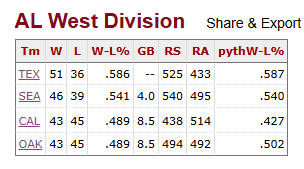
After all the twists and turns of the first half, players and fans buckled up to take the ride.
Notes
- Another notable pick in the draft was future Mariner stalwart and South Kitsap High School Wolves legend Willie Bloomquist in the eighth round. Bloomquist, however, opted to accept a scholarship to play at Arizona State University rather than sign immediately with his hometown team. The Mariners would get their guy eventually; they’d draft him again in the third round of the 1999 draft and bring him home.
- The Moonlight Graham Show: Seattle Mariner and Cyclone Baseball Standout Matt Wagner, June 4, 2020 https://www.moonlightgrahamshow.com/podcast/matt-wagner
- Finnigan, Bob. "Bob Wells Quietly Joins League's Pitching Elite." The Seattle Times, June 24, 1996: F5.
- LaRue, Larry. "Mariners Updated: Count Milacki Back in Rotation." The News Tribune, June 7, 1996: C8.
- LaRue, Larry. "A Night to Forget for the M's, Wolcott Struggles in 9-5 loss." The News Tribune, June 8, 1996: C3.
- Street, Jim. "M's Tap Three-Pronged Power Source." Seattle Post-Intelligencer, June 14, 1996: E5.
- Street, Jim. "Thomas Lays Big Hurt on M's with Long Ball, Alvarez Holds M's to Five Hits." Seattle Post-Intelligencer, June 15, 1996: B5.
- Reynolds, Bill. :Commentary: Baseball's Version of Slam Dunk; Owners Want 'Home Run Derby'." The Seattle Times, June 16, 1996: D10.
- The previous longest stretch to begin a season was 21 games in 1985. The previous longest stretch during a season was 59 from April 20 to June 27, 1989. Street, Jim. "Jackson Not Worried About Inconsistency." Seattle Post-Intelligencer, June 8, 1996: C7.
- LaRue, Larry. "M's Starting Pitching Fails to Finish Again." The News Tribune, June 27, 1996: C1.
- LaRue, Larry. "M's Starting Pitching Fails to Finish Again." The News Tribune, June 27, 1996: C1.
- Finnigan, Bob. "Mariner Starters Can't Finish." The Seattle Times, June 27, 1996: C8.
- Finnigan, Bob. "Pitches Speak for M's, Ayala's Fastball, Slider, Forkball Help Silence White Sox in 4-2 Win." The Seattle Times, June 23, 1996: D1.
- Knight, Bill. "Ayala Rejoins Team; Harikkala Sent Down." Seattle Post-Intelligencer, June 21, 1996: E4.
- Finnigan, Bob. "Pitches Speak for M's, Ayala's Fastball, Slider, Forkball Help Silence White Sox in 4-2 Win." The Seattle Times, June 23, 1996: D1.
- You may remember a docuseries that followed the St. Paul Saints that season called “Baseball, Minnesota”, which premiered in August 1996. https://www.imdb.com/title/tt0115107/?_ssoLoop=1
- Boling, Dave. "Rodriguez Wants to Focus on the Now." The News Tribune, June 30, 1996: C1.
- Boling, Dave. "Rodriguez Wants to Focus on the Now." The News Tribune, June 30, 1996: C1.
- Finnigan, Bob. "Mariners Can't Walk the Talk, Catcher's Verbal Games Jab Rodriguez." The Seattle Times, June 24, 1996: F1.
- https://www.cbsnews.com/newyork/news/sweeny-a-rods-reputation-shattered-again-thoughts-on-mlbs-ped-fight/
- LaRue, Larry. "Piniella Wonders If M's Can Stay Close." The News Tribune, June 30, 1996: C1.
- https://www.sfgate.com/sports/article/A-s-the-latest-stop-on-Suzuki-s-long-ride-2522734.php
- https://www.mlb.com/news/mac-suzuki-first-american-league-japanese-play-c188281754
- Finnigan, Bob. "The Hard Way is Mariners' Way, Seattle Survives Injuries to Stay Playoff Contender." The Seattle Times, July 8, 1996: C1.
Comments ()