
The 1996 Seattle Mariners, Part 3
In May, the walls start shaking, the earth was quaking, the Mariners were aching, and the duality of the pitching and offense was at its mid-90s Mariners best.
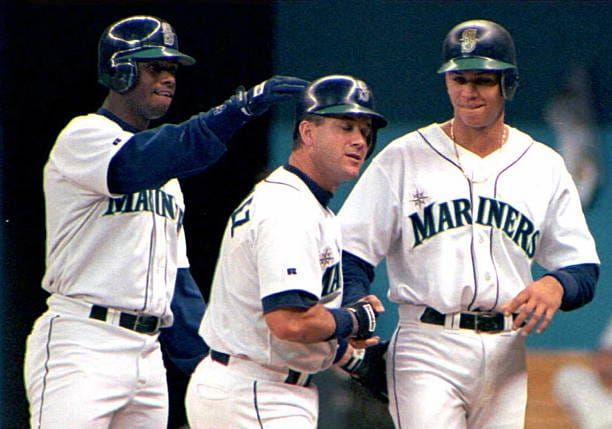
The Mariners put up the best April in their history and still found themselves limping home after a 3-and-4 road trip to wrap up the month. Players were falling to injuries, and their ace pitcher had concerning, nagging pain in his last few starts. But the baseball schedule doesn't allow time to stop and lick your wounds.
So, on the Mariners went, into May. First up, the team that broke their hearts and ended their magical run in October 1995.
May 2 - Cleveland 6, Mariners 4
(Completed on 5/3, suspended due to earthquake)
The 1995 ALCS rematch was suspended in the bottom of the seventh inning when an earthquake interrupted a Mariners rally. When the game resumed the following night, the Mariners were unable to complete the rally.
The Supersonics won their first playoff series, eliminating the Sacramento Kings.
May 3 - Cleveland 5, Mariners 2
Sterling Hitchcock struggled on the mound and the Mariners offense was anemic, scoring the only runs of the game when Cleveland catcher Tony Pena violates an obscure rule by picking up a baseball with his catcher’s mask.
May 4 - Mariners 5, Cleveland 1
Paul Menhart earned his first major league win as a starter. On Edgar Martinez jersey night, Edgar hit two home runs, the 99th and 100th of his career. Ken Griffey Jr. and the newly recalled Darren Bragg also contributed home runs.
“Always Be My Baby” by Mariah Carey hit number one the Billboard Hot 100 chart, replacing “Because You Loved Me” by Céline Dion.
May 5 - Cleveland 2, Mariners 0
The Mariners suffered their first shutout loss of the season at the hands of veteran Dennis Martinez. Chris Bosio pitched well again, and Ken Griffey Jr. robbed Albert Belle of a home run.
The Craft, a movie that became a staple at sleepovers for the rest of the decade, was number one at the box office.
May 6 - Mariners 5, Twins 4
Edwin Hurtado started in Randy Johnson’s spot and was helped by Ken Griffey Jr.’s three “dazzling” catches. The Mariners came from behind after being down 4-1 on the strength of another Darren Bragg home run and back-to-back home runs from Jay Buhner and Paul Sorrento. Rich Amaral had the winning pinch-hit RBI single.
May 7 - Twins 2, Mariners 0
Bob Wolcott went a career long 7 1/3 innings, only allowing one run, but the Mariners didn’t have a hit until the fifth inning and couldn’t score in Alex Rodriguez’s return from the DL.
May 8 - Twins 7, Mariners 5
Sterling Hitchcock remained winless since April 12th. The Mariners lost in extra innings when Dave Hollins led off the 10th inning with a double that bounced off of Darren Bragg’s glove. Dan Wilson hit his eighth home run of the season.
May 10 - Royals 14, Mariners 10
Chris Bosio struggled, giving up nine runs in 4 2/3 innings. Ken Griffey Jr. hit two home runs and Brian Hunter drove in a career-high four runs.
Twister was released and inspired a generation of storm chasers.
May 11 - Mariners 11, Royals 1
Bob Wolcott pitched well on three-days rest and the offense exploded after a “terse” pre-game meeting. As a team, the Mariners hit eight doubles and Jay Buhner and Paul Sorrento hit home runs.
ValuJet Flight 592 crashed in the Florida Everglades, killing all 110 people aboard.
Eight climbers died in a blizzard on Mount Everest.
May 12 - Mariners 8, Royals 5
Randy Johnson started and was forced to leave with leg cramps in the fifth. The Mariners offense hit eight more doubles and Alex Rodriguez hit two home runs.
The Supersonics vanquished the Houston Rockets in four games to advance to the Western Conference Finals.
May started with an earthquake. (No word on birds, snakes, aeroplanes, or the status of Lenny Bruce’s fear.)
Cleveland’s baseball team dared to come back to the Kingdome after the devastation they’d wrought in October. Bob Wolcott, the Mariners hero of Game One of the ALCS against said Cleveland baseball team, didn’t fare as well this time around. He surrendered six runs, but the Mariners offense had no fear; they were mounting a comeback in the bottom of the seventh inning. After Edgar Martinez hit a two-run home run and Paul Sorrento reached on a one-out single, Orel Hershiser was dismissed from the game for Cleveland and Julian Tavarez was called in.
Just as the pitching change was made the ‘Dome stared shaking, and not because fans were excited about the impending rally. It was a 5.3 earthquake, and officials quickly made the decision to suspend the game and check the building for damage. It passed with flying colors, and the Mariners lost the game the next night.
 Amanda Lane Cumming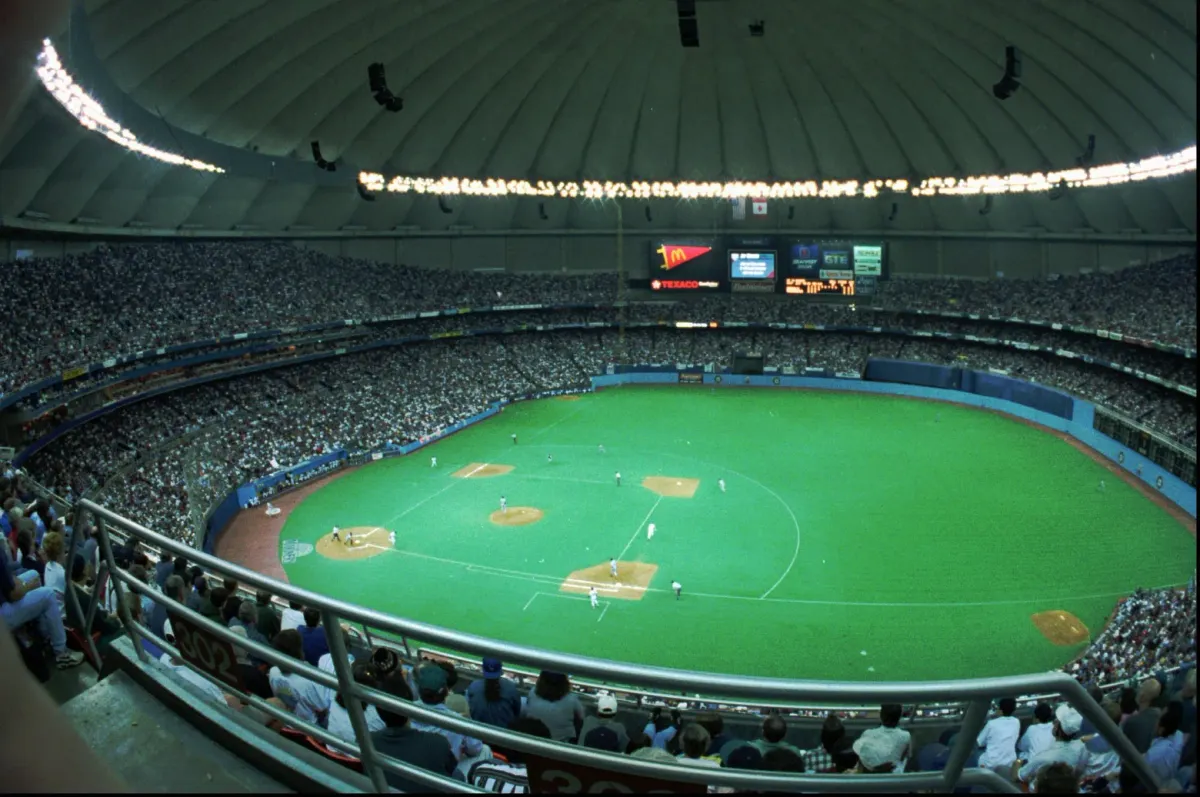
May also started with bad news for the natural disaster that was the Mariners starting rotation. Before the earthquake game, the team announced that Randy Johnson would miss his next start due to nerve irritation in his lower back. Trainer Rick Griffin said the calf problem in his last start stemmed from that irritation.1 Everyone believed—or hoped—extra rest would solve the problem and Randy would be able to start next time his spot came up.
Still more injuries plagued the Mariners as Ricky Jordan injured his right shoulder. Jordan signed at the end of spring training to provide a right-handed counterpart to Paul Sorrento at first base and right-handed bat off the bench. Jordan missed the entire 1995 season after having major shoulder surgery and either hadn’t fully healed or aggregated the injury. Onto the 60-day disabled list he went. To take his place, Brian Hunter was promoted from Tacoma.
Darren Bragg was also recalled from Tacoma. Piniella wanted more from the leadoff spot than he was getting from Joey Cora and hoped Bragg could generate some run-scoring opportunities. He made Piniella quite happy by leading off Mariners hitters with a home run in the bottom of the first inning of his first game back on May 4th. Two games later, he did it again against the Twins with a 402-foot shot that reached the upper deck.
The next night Bragg had three singles, which prompted Bud Withers of the Seattle Post-Intelligencer to muse that perhaps Bragg was “the left fielder the M’s have been looking for since about the time Danny Kaye owned the team.”2 He continued hitting well for the rest of the month, putting up the best numbers he’d had in the major leagues so far, slashing .301/.381/.466 with three home runs and seven RBI. His hitting would cool off slightly in June, but he posted a .427 OBP, exactly what you want in the leadoff spot.
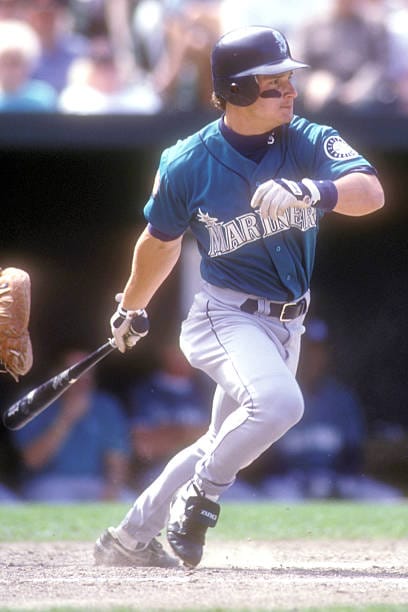
Alex Rodriguez returned from the disabled list with his hamstring injury. After batting in his familiar ninth spot the first game back, he was moved up in the batting order to the second spot. Piniella had been contemplated the lineup change before his injury. In his first night there, he hit an RBI double and from that night on, the second spot was his. He ran with it all of May, slashing .393/.411/.719 while slugging seven home runs and driving in 25 RBI. Whatever the Mariners had hoped Alex Rodriguez could be, he was fulfilling their wildest dreams.
The changes at the top of the order were a big boost before the big bats of Ken Griffey Jr., Edgar Martinez, and Jay Buhner came to the plate. Still, it took a little while to get the offense firing, and in the first eight games of the home stand, the Mariners dropped six. After losing their third game in a row, Piniella held a closed-door team meeting before the next game. He told the players they needed to “refocus, to play hard and not be ashamed of losing well-played games.”3 His speech was described as “terse”, but he was right. The current roster was the most talented group of the players the Seattle Mariners had ever had in their history. They had a lot of young pitchers, and three players on the field who were playing their first full major league seasons (Alex Rodriguez, Russ Davis, and Darren Bragg). It was only natural that they’d run into bumps along the way.
The speech worked, and the Mariners won the final two games of the home stand. Randy Johnson did, in fact, make his next scheduled start, going five plus innings and earning the win. But his injury troubles were far from behind him. In the fifth inning he began feeling leg cramps and left after throwing only 97 of his “small” pitch limit of 110.
The losses on the home stand pushed the Mariners four games behind Texas in the division, with the A’s and Angels right on their heels. There was no time to worry. They had a plane to catch to New York.
May 14 - Yankees 2, Mariners 0
The Mariners were no-hit by Dwight Gooden, the first time they had been no-hit by a single pitcher in their history.
May 15 - Mariners 10, Yankees 5
Chris Bosio gave up a four-run lead, then left the game in the second inning. The bullpen came through, only allowing one additional run as the offense made up for being no-hit the night before with 19 total hits; each position player had at least one.
May 17 - Orioles 14, Mariners 13
Bob Wolcott only made it to the third inning in a slugfest at Camden Yards. Alex Rodriguez hit a grand slam. Norm Charlton blew his first save of the season in the longest nine-inning game in Mariners history.
May 18 - Mariners 7, Orioles 3
Bob Milacki made his first start and earned the win in his 5 1/3 inning effort. Norm Charlton redeemed himself by holding a four-run lead. Alex Rodriguez hit a home run and robbed his childhood hero, Cal Ripken, of a hit in the field.
May 19 - Orioles 8, Mariners 7
Seattle pitchers failed to hold three separate leads while Seattle hitters slugged four home runs.
May 21 - Mariners 13, Red Sox 7
Chris Bosio’s knees hampered him as he allowed five Boston runs in the third inning before exiting the game. Ken Griffey Jr. hit the 200th home run of his career. Jay Buhner hit a home run in his fifth consecutive game. Rich Amaral, Alex Rodriguez, and Griffey each contributed three hits, and Edgar stole the show with four.
The series finale of The Fresh Prince of Bel-Air aired the night before. Ken Griffey Jr. guest starred on an episode in 1994.
May 22 - Mariners 6, Red Sox 1
Lou Piniella became the winningest manager in Mariners history, passing Jim Lefebvre. Bob Wolcott earned his third win of the season, despite walking five. Russ Davis and Darren Bragg each hit home runs during a five-run fifth inning.
Susan Lucci did not win the Daytime Emmy Award for the 16th time.
May 23 - Red Sox 11, Mariners 4
Roger Clemens beat the Mariners and got his first major league hit off Norm Charlton in the eighth inning. Bob Milacki was pulled in the fifth. Ken Griffey Jr. hit his 12th home run of the year.
The trip to New York was a reception with the past. The last time the Mariners were there, in October, they dropped the second game of the five-game division series in a brutal 15-inning loss. And when the Mariners need to drop payroll in the offseason, they chose the Yankees as their trading partner, sending Tino Martinez and Jeff Nelson back east in exchange for Russ Davis and Sterling Hitchcock. It could have been an emotional reunion, but the players mostly downplayed the significance.
Hitchcock, who started the first game of the series at Yankee Stadium, went so far as to scoff at the mythology around the Yankees and their mystical pinstripes, telling reporters that “polyester is polyester.”4 Burn.
When Hitchcock was traded to the Mariners, it opened a spot in the Yankee rotation. They filled it with former cross-town Met Dwight Gooden. Gooden’s struggles with addiction during his career (and, later, after) have been well documented; he missed the entire 1995 season serving a suspension after testing positive for cocaine while serving a prior suspension. Gooden started the first game of the road trip against the Mariners.
Darren Bragg led the game off with a walk, then Alex Rodriguez hit a deep fly ball to center field. Gerald Williams, covering for an an injured Bernie Williams, went back and made a spectacular catch and doubled off Bragg. It turns out, the first fielding chance of the game was the incredible play that saved the no-hitter.
It was the first time the Mariners had been no-hit by a single pitcher, a fact that seems unbelievable considering how offensive the Mariners offense had been for most of their history. The only other time they had not had a hit as a team was when Mark Langston and Mike Witt combined to hold them hitless in 1990.
The Mariners bounced back the next night, shaking off being no-hit to score 10 runs. Jeff Nelson made an appearance in relief against his former team, walking Russ Davis and giving up singles to Bragg and Rodriguez before he was taken out of the game. Tino Martinez, who had struggled to begin the season, was picking it up in May and led the Yankees with three RBI in the series against his former team.
The bounce back win was a good sign of resilience for the Mariners, a trait they needed in May. On the flight to New York, Randy Johnson was unable to get comfortable and aggravated his back and leg injury. He was put on another flight back to Seattle for evaluation and was diagnosed with an “irritation of a nerve down his right leg.”5 He was put on the 15-day DL and everyone crossed their fingers that it would only be a two to three week stint.
The entire pitching staff was having trouble finding their groove and the loss of Randy Johnson was a huge blow. In addition to having matured into a perennial Cy Young Award contender (and actual Cy Young Award winner), he was also a workhorse. In 1995 he pitched 214.1 innings, averaging 7 1/3 innings per start. Piniella was continually frustrated by the rotation’s inability to go deep into games. “We can’t keep asking for five, six, seven innings a night from our relievers,” he said. “You don’t win many games using four or five pitchers…and the more you have to use those guys, the more often one of them is going to get tired and struggle.”6
Mariners starters weren’t going deep into games, much less medium into games. A starter hadn’t pitched at least six innings since Hitchcock’s start on May 8th, and wouldn’t in a single game on the road trip.
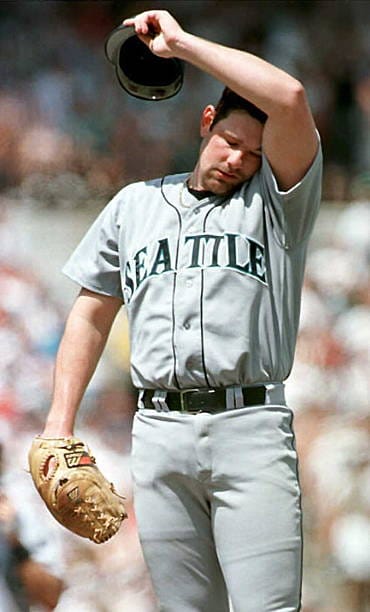
The rotation got another huge blow when Chris Bosio, who said his knees felt great at the end of April, left his start in Boston in the third inning, after leaving his previous start in New York in the second. “He’s hurt,” Piniella said. “His last few starts, it’s gotten worse. He can’t use his lower body when he throws to the plate, he can’t drive toward the hitter. He just tries to rock and throw. He’s hurting.”7
It wasn’t surprising that Bosio’s knees hurt. The simple fact that he’d needed, and already had, seven knee surgeries indicated it was a problem that could not be fixed. He was evaluated and diagnosed with arthritis, and said the knee felt the way it had during spring training. He was initially placed on the 15-day DL and advised to rest as much as possible. Near the end of the month, he was moved to the 60-day DL, and rumor had it, he wouldn’t pitch for Seattle again.
The duality of the mid-90s Mariners meant that while it was doom and gloom on the pitcher’s mound, the offense was having a great time. Every starter had at least one hit when the Mariners exploded for 19 hits the day being no-hit. After New York, they moved on to Baltimore for a slugfest of a series with the Orioles.
Jay Buhner hit home runs in each game of the series, two in the final game. Alex Rodriguez hit two, including a grand slam in the first game. Dan Wilson continued his hot hitting with a home run, as did Edgar Martinez. Over the three-game series, the Mariners walloped 44 hits and scored 27 runs. The duality of the mid-90s Mariners meant they only won one of those games.
Assistant general manager Lee Pelekoudas was along on the trip, tasked with looking at ballparks and gathering ideas for the Mariners’ new park. Since its opening in 1992, Camden Yards had received a fair amount of criticism for its small dimensions. After the ball continually fly over the outfield walls, including the game-winning grand slam hit off of Norm Charlton, Pelekoudas assured the traveling reporters that the new ballpark in Seattle wouldn’t play like that.8
When the Mariners moved on to Boston, Ken Griffey Jr. had not hit a home run in 35 at bats. He corrected that by hitting a three-runner for the 200th home run of his career. After his slow start, his numbers were slowly rising. As for the mysterious ailments that were causing dizziness and weight loss? It was all brushed off off as an ear infection, weight loss from the flu, and Griffey opting to wear a larger pants size for comfort. After the stories ran in Seattle newspapers about his weight loss, trainer Rick Griffin said he got a call from a Los Angeles newspaper asking if the center fielder was dying of AIDS.9
That is such a wild conclusion to which a jump could be made, that I’m not sure what to say about it.
The road trip ended with the Mariners having lost Randy Johnson and Chris Bosio, but they managed to pull out a .500 trip. Now, it was back to the Kingdome to face the Yankees, Orioles, and Red Sox all over again.
May 24 - Mariners 10, Yankees 4
Edgar Martinez taunted the Yankees with a flashback to the 1995 Division Series with a double down the left field line to score Griffey from first. Ken Griffey Jr. had the first three-home run night of his career and Sterling Hitchcock pitched seven innings, finally giving the bullpen a break.
May 25 - Yankees 5, Mariners 4
Edwin Hurtado began the game well, then allowed five Yankee runs in the third inning. Solomon Torres pitched a scoreless 5 2/3 out of the bullpen.
May 26 - Mariners 4, Yankees 3
The Mariners beat Dwight Gooden in a rematch. Edgar Martinez hit a massive three-run home run into the upper deck. Tension rises when Dan Wilson is nearly hit by two pitches, seemingly in retaliation for a pitch that hit Gerald Williams. Norm Charlton earned a two-inning save.
Three of President Bill Clinton’s former business partners in the Whitewater land deal were convicted of fraud.
May 28 - Orioles 12, Mariners 8
All 12 Orioles runs came on home runs, six in total. Mariners pitching hasn’t given up that many home runs in a game since 1977. Ken Griffey Jr. continued his hot hitting with a home run and three RBI doubles.
May 29 - Mariners 9, Orioles 8
Russ Davis nearly blew the game with an error in the top of the ninth inning that allowed the Orioles to take the lead. He redeemed himself and won it for the Mariners in the bottom of the ninth with a game winning single off the right field wall with the bases load, two outs, and a 3-2 count.
The Space Shuttle Endeavor landed safely after a mission.
May 30 - Red Sox 10, Mariners 1
Solomon Torres allowed eight earned runs in 5 1/3 innings. The only Mariners run came Paul Sorrento’s 11th home run of the year.
May 31 - Mariners 9, Red Sox 6
Ken Griffey Jr. and Alex Rodriguez each hit three-run home runs to lead the Mariners to a come-from-behind victory after being down 5-1.
June 1 - Red Sox 6, Mariners 5
Mo Vaughn hit a massive home run to put the Red Sox ahead and a Ghost of Mariners Future, Healthcliff Slocumb, retired the last four Mariners in order.
June 2 - Mariners 3, Red Sox 1
Bob Wolcott had an outstanding start, pitching into the seventh inning. Ken Griffey Jr. stole the 100th base of his career and became the first Mariner to reach triple digits in each category.
The Supersonics won Game Seven of the Western Conference Finals, defeating the Utah Jazz and winning a shot at the Chicago Bulls for the NBA Championship.
The injury bug continued nipping at the Mariners during the home stand. Even Lou Piniella complained about his own sore back. Jay Buhner was removed from the second game of the home Yankee series with a sprained right knee. Luckily, he only missed one game. In the final game of that series, Alex Rodriguez had to cut his batting practice short and take a nap in the clubhouse because he had an upset stomach. It didn’t hold him back though; he hit a home run, a double, and two singles.
The most severe injury was sustained by Tim Davis. Davis was hit in the shin with a line drive when the Mariners were in New York. The leg continued to bother him, but he was able to pitch on it. Then, in the Yankee home finale, he ran to cover first base and the leg gave out. X-rays determined it was broken. Piniella wasn’t shy about sharing who he was considering calling up from Tacoma, but this time, he didn’t know what to say after this latest blow to his pitching staff, which had already sustained a season’s worth. He said he’d leave the decision to general manager Woody Woodward. The winner was veteran reliever Lee Guetterman.
The Mariners faced the Orioles again, and again it was a high-scoring affair. Home run totals had been steadily increasing across baseball. A number of reasons were given for this. Expansion led to more home runs by virtue of more teams and a depleted pitching pool. Players were beginning to lift weights and realized they could gain a competitive advantage by taking care of themselves. And, of course, there were steroids, though no one was discussing those as a possibility at the time. A favorite conspiracy theory was that the ball was juiced, not the players.
One of the symbols of the nascent steroid era in baseball was the Orioles’ Brady Anderson. He hit his 10th home run against the Mariners in their first game in Baltimore, and his 20th in the final game of their series at the Kingdome. He’d go on to hit 50 home runs that year, a staggering total for a player whose career high was 21 in 1992. Though Anderson was never linked to performance enhancing drugs, and he’d never approach the 50 home run mark again (his next highest total was 24 in 1999), he was a symbol of the power explosion.
For all the offense in baseball, hitting that baseball remained incredibly difficult. As physically challenging as baseball could be, for players who reached the major league level, the difference between success and failure often came down to the mental approach. So it was with Russ Davis.
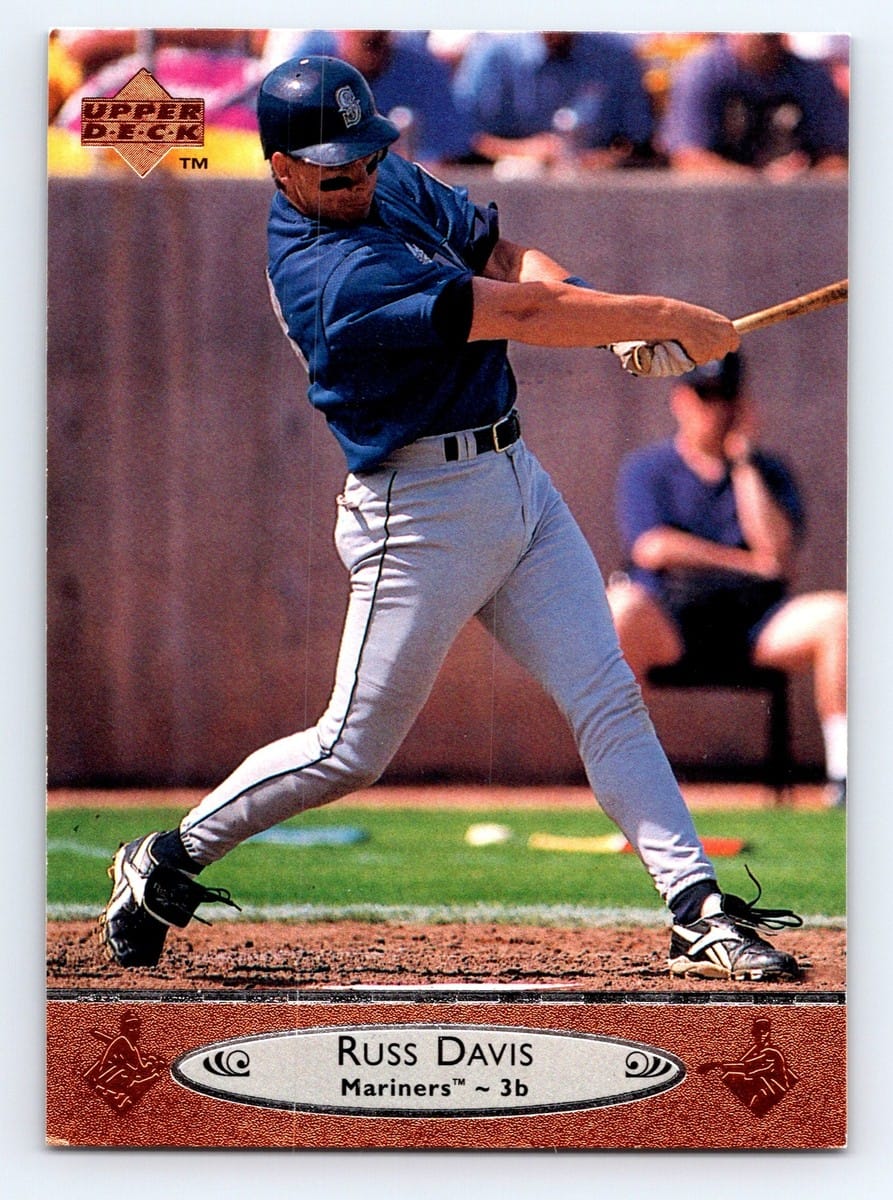
The scouting reports on him raved about his quick hands and power potential. He was projected as a 20 home run, 90 RBI guy at the plate. Defensively, he was praised for his soft hands and strong throwing arm.10 The Yankees turned him from a shortstop into a third baseman, but he was blocked in New York at third by Wade Boggs and had limited major league playing time before the 1996 season. He was struggling to adjust to all major league pitching all the time.
He had flashes where it looked like his bat was breaking out, but going into the home stand he was slashing .252/.331/.407 with four home runs and 15 RBI, not exactly the power numbers the Mariners hoped for. The playing time he did have in New York came primarily against left-handers. At the worst of his slump, the Mariners considered replacing him entirely at third base with Luis Sojo. Eventually they decided on a platoon with Doug Strange until Davis could get things figured out.
Batting coach Lee Elia loved a project, and he wanted to figure Davis out. He said of his young charge, “He has to trust his hands, be more aggressive. He’s taking too many pitches, too many strikes.” After the May 19th game in Baltimore, Davis expressed his frustration at the plate, “I feel like I’m close. I hit a couple balls hard the other night, felt real good swinging the bat, then today it was like I took a big step backward. I’m pressing, I’m not relaxed. This can’t keep going on. I’m not letting the bat go.”11
Piniella urged Davis to relax. “He’s pressing, and sometimes backing off helps.” He also believed that Davis had what it took to succeed in the big leagues. “He may be playing as well defensively as any third baseman in the league…We’ve got to get him hitting, and he can’t hit the way he’s going about it now…He’s got great skills, so it’s not that, it’s just approach.”12
On May 29th, facing the Orioles in Seattle, it all culminated in what felt like a turning point for Davis. He committed an error in the top of the ninth inning that allowed the Orioles to take the lead. In the bottom of the ninth, the Mariners began to rally. Griffey hit a one-out solo home run off Randy Myers to tie the game. Edgar followed with a double to put the winning run technically in scoring position. Due to the lack of speed at second, Piniella considered pinching running Rich Amaral, but he worried that if they couldn’t score and the game went into extra innings the Orioles wouldn’t pitch to Griffey with Amaral behind him. So Edgar remained at second.
Jay Buhner was intentionally walked. Brian Hunter pinch hit for Paul Sorrento and rewarded the match up with a single to load the bases. Dan Wilson hit into a fielder’s choice that forced out Edgar at home, and Russ Davis came to the plate with the winning run 90 feet away and two outs.
Piniella wanted to pinch hit for Davis, but Elia stepped in. “This could be the at bat that makes the difference,” he told Lou.13 Elia told Davis that Myers would stay on the outside part of the plate. After working the count 3-1, Davis fouled off a fastball. With a full count, Myers went a little higher with the fastball and Davis rewarded Elia’s faith by lining it off the wall in right center and driving in the winning run.
After hitting his 200th home run in Boston, Griffey finally found his groove. Between May 21st, when he hit that home run, through the end of the home stand on June 2nd, Griffey was slashing .426/.500/1.064. He hit six doubles, eight home runs, stole four bases, and drove in 22 runs. Not bad for a guy a newspaper speculated may have been dying of AIDS.
Everyone had crossed their fingers and hoped that Randy Johnson wouldn’t be out much longer than the initial 15-day DL stint. But Piniella was forced to admit that he’d be out much longer. It wasn’t possible to get a good timeline, however, because rest and relaxation wasn’t making a difference. Randy was frustrated and the medical staff was baffled. The nerve causing the irritation simply wasn’t quieting down, but nothing else seemed to be wrong.
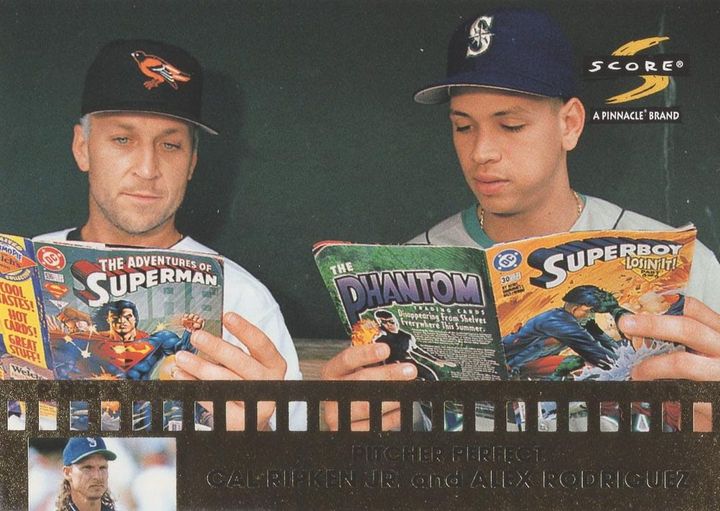
He found ways to occupy himself while he sat around waiting for his nerve irritation to calm down. Pinnacle Card Co asked him to take pictures of major league players for a special card set. Pinnacle would use about a dozen photos for cards, but Randy contemplated that he could put the rest in a book.
When the Orioles were in town, he photographed Robbie Alomar posing on a tractor used by the Kingdome groundskeepers. It sounds like players were happy to let Randy take pictures of them. But, he said, “Maybe they’ll think they have to or I’ll remember when they come to the plate against me.”14
He also had big plans for his teammates. "I'm going to get Junior on top of the center field fence with a ball in his glove and the 405-foot mark just under his legs," Johnson said. "I want to get a golf bag, fill it with bats and have Edgar carrying that. And I'm going to shoot Alex sitting in the clubhouse reading a 'Superboy' comic book."15
Perhaps having something else to focus on helped. Because, finally, as the home stand came to a close, Randy reported that he’d started physical therapy on his back and was feeling some improvement. Minor though it may have been, it was a step toward getting him back.
The month of May saw a tremendous amount of shuffling in the starting rotation and bullpen. At the beginning of the month, the rotation was Randy Johnson, Chris Bosio, Sterling Hitchcock, Bob Wolcott, and Paul Menhart. It didn’t stay that way. When Randy Johnson missed a start, Edwin Hurtado moved into his spot in the rotation, when Randy went on the DL Scott Davison was called up from Tacoma.
After his first win on May 4th, Paul Menhart was sent down to Tacoma. It was a matter of timing; the Mariners didn’t use a fifth starter for a few weeks and after his encouraging start they wanted to keep him on a regular schedule. To fill his spot on the roster, Joe Klink was called up from Tacoma. Klink gave the Mariners three lefties in the bullpen, along with Tim Davis and Norm Charlton. Klink didn’t last long with the Mariners. He was outrighted to Tacoma and Bob Milacki, who’d been pitching well in AAA, was called up.
On May 25th, Solomon Torres was called up, intended to be another bullpen piece. After he pitched 5 2/3 scoreless innings Piniella moved him into the rotation. Unfortunately, his first start went horribly. Hurtado, who had struggled all season, was sent down to Tacoma and Menhart was brought back up. Lee Guetterman became the newest member of the pitching staff when Tim Davis broke his leg.
Dizzy yet?
The final pitching shuffle of the month came when Bob Wells pitched 4 2/3 scoreless innings in relief on May 31st. Piniella, not worried about moving pitchers into the rotation based on a good long relief appearance after the experience with Torres, moved Wells into the rotation. Except, Piniella was so eager to make the change, he told reporters about the change before he told Wells and Wells found out when he was approached by reporters after the game.16 He accepted the news happily.
By the end of the month, with the significant losses of Johnson and Bosio, the starting rotation was some combination of Hitchcock, Wolcott, Menhart, Milacki, and, temporarily Solomon Torres, and the soon-to-be-added Bob Wells.
Over the month of May, the Mariners were slightly below .500, at 12-and-14. Considering the challenges they’d faced with the loss of their two best starting pitchers, it was a respectable month. Overall, when the home stand wrapped up on June 2nd, they were 29-and-25, sitting 4.5 back of the Texas Rangers.
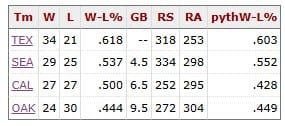
If May had tested their mettle, June was the month to show what they were made of.
Notes
- Condotta, Bob. "Mariners Update: Randy Johnson to Miss a Turn with Nerve Injury." The News Tribune, May 3, 1996: C3.
- Withers, Bud. "Parra Quiets M's Bats - Wolcott Effort Goes for Naught." Seattle Post-Intelligencer, May 8, 1996: D1.
- LaRue, Larry. "Mariners Update: Piniella Calls Team Meeting, Hopes to Boost Team Morale." The News Tribune, May 12, 1996: C6.
- Finnigan, Bob. "Mariners Escape from NY, Team Pounds 19 Hits." The Seattle Times, May 16, 1996: C1.
- "Johnson Diagnosed with Nerve Irritation in Leg." The Seattle Times, May 16, 1996: C4.
- LaRue, Larry. "Mariners Update: Piniella: Pitchers Must Do Better Job." The News Tribune, May 19, 1996: C8.
- LaRue, Larry. "Great for Griffey, Grief for Bosio." The News Tribune, May 22, 1996: C1.
- Finnigan, Bob. "Cozy Camden Yards a Nightmare for M's." The Seattle Times, May 20, 1996: C1.
- LaRue, Larry. "Mariners Update: Junior Watch: Weight Loss About Average." The News Tribune, May 24, 1996: C6.
- Harper, John. "Hot Property, Davis: The Yankee farmhand everybody wants." The Daily News, February 6, 1994: 82-83.
- LaRue, Larry. "M's, Davis Still Struggle." The News Tribune, May 20, 1996: C3.
- LaRue, Larry. "Mariners Update: Strange Will Platoon with Davis at Third." The News Tribune, May 22, 1996: C7.
- LaRue, Larry. "Mariners Update: Davis Almost Didn't Get Chance at Winner." The News Tribune, May 31, 1996: C7.
- "Doubles by Martinez Start to Get Monotonous." The Seattle Times, May 30, 1996: D5.
- LaRue, Larry. "Mariners Update: Johnson Focuses In On Other Passion." The News Tribune, May 30, 1996: C5.
- LaRue, Larry. "Two 3-Run Homers Save M's From Dreadful Pitching." The News Tribune, June 1, 1996: C1.
Comments ()