
The 1996 Seattle Mariners: Navigating a New Identity, Part 1
The magic of 1995 had come to an end. This is the story of what happened next, from the curtain call to Opening Day 1996.
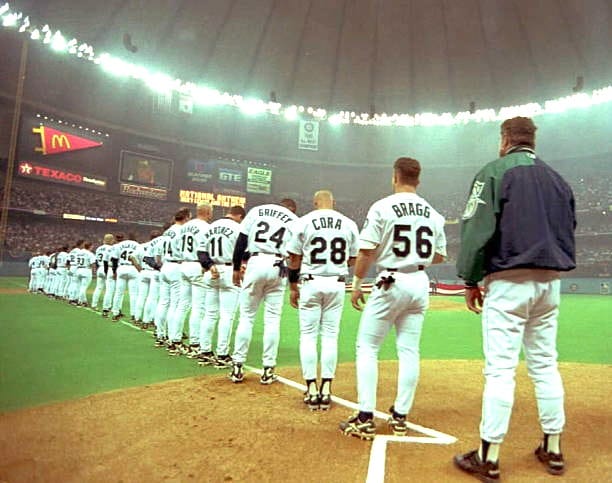
Welcome to Part 1 of a year-long series on the 1996 Seattle Mariners! 1996 is a fascinating year because it’s the year the Mariners shed the threats of relocation, the decades of losing, and the designation of being the laughingstocks of baseball to become a real baseball team. A team that proved it could contend. A team that carried expectations for the first time in its history.
As the 2026 version of the Mariners begins the season after coming within a few outs of the World Series, let’s take a look back at the team 30 years ago and how they learned to navigate a new reality.
“I was told I was going to fail here. I was told this wasn’t possible.”
Lou Piniella shared those words, the consensus among his friends in baseball when he took the managing job in Seattle, after the Mariners lost the 1995 American League Championship series to Cleveland. Piniella was brought aboard the Mariners in 1993, a former World Champion in New York as a player and Cincinnati as a manager. No one could understand why he would go to Seattle, perennial losers that they were.
“I was unemployed at the time,” he winked.1
In his third season with the club, the Mariners evolved into a baseball team. They ascended from the primordial goo in which they’d spent most of their existence and assumed the form of a major league baseball team with an ace starter, a star center fielder, and a colorful cast of supporting characters. Facing the possibility of relocation, of becoming the second team to leave Seattle, they dug deep and found that human element that rises to big occasions.
In the comeback that culminated in a one-game playoff to win the American League West, in Ken Griffey Jr racing around the bases in extra innings to win the Division series, and in playing to within two wins of the World Series, the Mariners achieved something that was inconceivable even a year earlier.
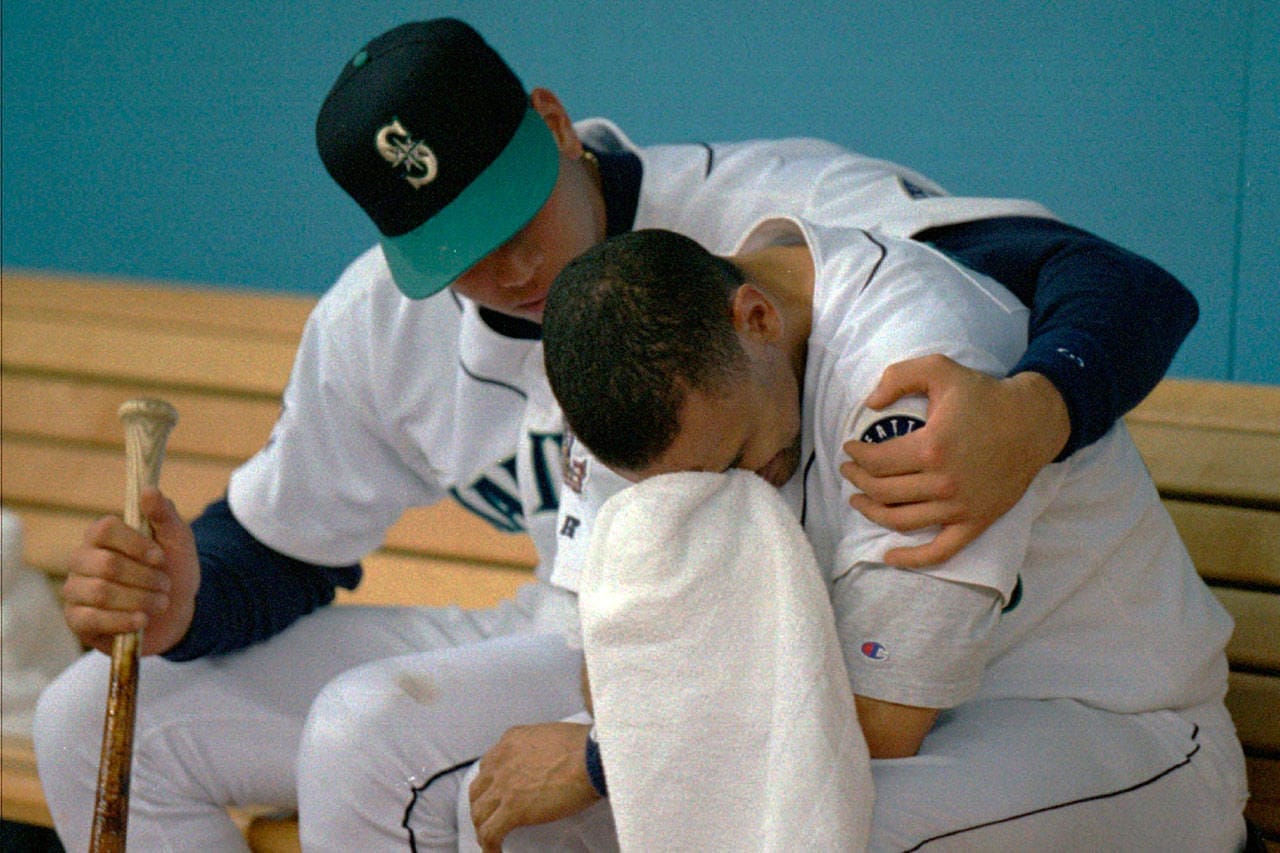
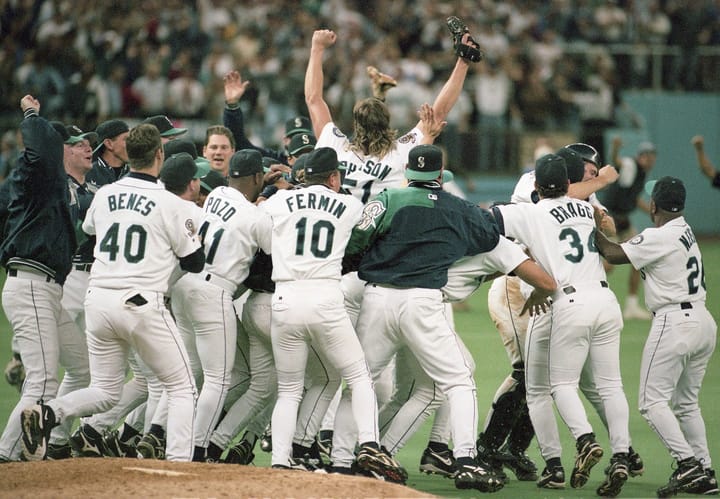
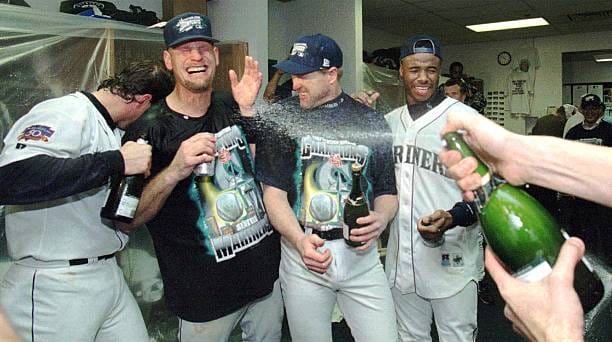
The 1995 season ended when Jay Buhner grounded out to third, briefly silencing the tremendous Kingdome crowd. Then, it roared. Nearly 60,000 fans stood on their feet and cheered for the Mariners. Through the tears in the stands and in the dugout, 19 long years of frustration, and the magic of 1995, was over.
Now what?
The answer wasn’t as simple as coming back and trying to make it further next year. There was stadium funding and payroll considerations. They had free agency and arbitration and trades to strategize, and holes in the roster that needed to be filled.
It was the work, for the first time, of a real baseball team.
The New Stadium
For all the talk of the 1995 Mariners saving baseball in Seattle, it wasn’t a done deal when the season ended. After the ballot measure was narrowly rejected by voters, the ownership group began serious discussions with state and county leaders. Among the points of discussion were the Mariners’ insistence on a retractable roof, which added quite a bit to the projected cost of the new stadium, and a natural grass playing field.
The Mariners were unable to set their payroll until the stadium issue was settled; if funding couldn’t be secured the team would be put up for sale. That would mean a lower payroll. To avoid drawing it out, the group set an October 31st deadline for the politicians to figure it out.
Luckily for the owners, the Mariners’ success meant politicians were willing to risk making deals that would normally have been unpopular. Both the state legislature and the King County Council passed stadium funding measures a week before the deadline. Work immediately began to finalize a site and hire architects. A number of lawsuits were filed seeking to halt the stadium project for various reasons, mostly based on the voters’ rejection. Still, going into 1996, the future stadium, wherever it was to be built, was considered a done deal.2
Crunching Numbers
With success came higher ticket prices. It’s a fact of capitalist life, but it was an unwelcome development for legions of new fans. The most expensive tickets, the box seats on the 100-level, rose from $15 to $20. Ticket prices for kids rose between $1-$2 in various sections. It wasn’t all higher prices, though. Fans on a budget could sit in the left field seating area beneath the scoreboard for $5 a seat, down from $6.3
At least the ticket price hike came alongside a payroll raise. The Mariners began 1995 with a payroll of about $30 million. They’d begin 1996 at about $34 million. The extra boost came from a new MLB-wide television deal. The front office continued to say they lost a significant amount of money over the last two seasons due to the strike, and would continue to lose money until they moved into the new stadium.4 Team President Chuck Armstrong also tried to manage expectations regarding the roster and the players who would return by telling reporters it would cost about $40 million to keep the team intact.5
Even with the payroll increase and the assurances of the Mariners that they wanted nothing more than to keep the team together, it was clear that tough decisions loomed as a number of players were due for raises, either through arbitration or free agency.
1996 was a time of short-term contracts, leaving the Mariners with only a handful of players already locked down, including Jay Buhner, Chris Bosio, Randy Johnson, and Ken Griffey Jr. Further complicating their offseason plans was lingering uncertainty after the players strike, which was ended by a judicial ruling in April 1995. Until a new collective bargaining agreement was ratified, MLB operated under the old agreement. Ratification wouldn’t happen until the following winter, leaving teams in a liminal space where their roster building strategies could change. The Mariners were a small market team, then without the benefit of revenue sharing and luxury taxes.
Vince Coleman, Andy Benes, and Tim Belcher filed for free agency and the Mariners didd not pursue them, mainly due to financial constraints. Norm Charlton was also eligible for free agency if the Mariners did not offer arbitration. In addition, Mike Blowers and Tino Martinez were arbitration-eligible and looking at large raises because of their performances in 1995.
The biggest hole the Mariners needed to fill was in the starting rotation. They either needed to make trades, or grab someone on the free agent market. Because of their budget constraints, it looked like a trade was the best option. The Mariners identified Ken Griffey Jr., Randy Johnson, and Jay Buhner as their only untouchables as far as trades went. Sports writers speculated that Alex Rodriguez was probably included in that group as well.
Options, Extensions, and Trades! My Oh My!
The first significant move of the offseason was picking up the $3.5 million club option on Edgar Martinez’s contract. Then, before the season began, Edgar signed an extension through 1998 with a club option for 1999 worth about $9 million total. Appropriate for the designated hitter, who was so valuable at the plate he finished third in American League MVP voting from voters who were largely hostile to the idea of the DH.
The Mariners also quickly exercised their option on Joey Cora, who became a fan favorite thanks to his passionate play on the field and his tears in the dugout when the Mariners lost in the ALCS. In fact, fans connected with a lot of the Mariners players. It wasn’t the first time Mariners fans were attached to players, but it was the first time it happened at scale, and with so many players at once.
Those emotional attachments that had been formed so earnestly meant fans were not prepared when the business of baseball intruded. The first major trade was finalized on November 29 and hit hard. The Mariners shipped Mike Blowers away to the Los Angeles Dodgers for minor leaguers Miguel Cairo and Willis Otáñez.
The attachment to Blowers was deep. He grew up in the Tacoma area and played baseball at the University of Washington, making him a beloved home town player who was a big part of the late season run. But his $500,000 salary was set to double, perhaps triple, and there just wasn’t room in the budget. Nobody was happy to see him go, and Jay Buhner was “ticked.”
“I can’t believe we’re getting rid of a guy who was such an integral part of our stepping-stone year…I just hate to see us get rid of guys without making an effort to keep them,” he said.6 Even though they were in the baseball business, the players weren’t any happier with the offseason restructuring than the fans.
Now, the Mariners had an opening at third base. Luis Sojo, Doug Strange, and Arquimedez Pozo were names bandied about as suggestions to take over. But Mike Blowers supplied 23 home runs and 96 RBI. They had to replace that somewhere to stay competitive.
Across the country, the New York Yankees were getting closer to re-signing third baseman Wade Boggs. They had an opening at first base following Don Mattingly’s retirement and a young third baseman whose power was sure to play well in the Kingdome. Tino Martinez was projected to win at least $3 million in arbitration. With the Mariners payroll sitting just below $30 million, that was a blow they couldn’t absorb.
On December 7, a date which will live in infamy, after weeks of rumors and speculation, Tino and relief pitchers Jeff Nelson and Jim Mecir were traded to the Yankees. In exchange, they received the starting pitcher they sought in Sterling Hitchcock and a replacement for third base, rookie Russ Davis. On paper, the trade addressed a couple gaping holes, but on the heels of trading Blowers Mariners fans were understandably upset about losing another huge piece of the 1995 team.
(I wrote all about the Tino Martinez trade several years ago. If you’re interested in going in depth on all the rumors and jockeying between the Mariners and Yankees, check it out on Lookout Landing: )
 Amanda Lane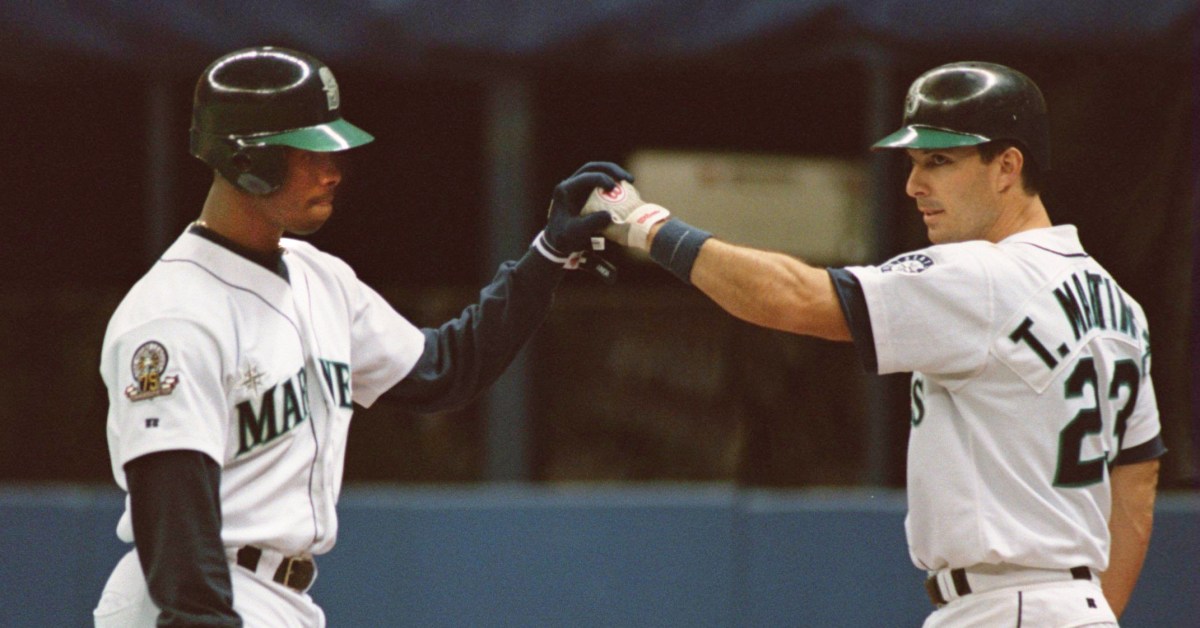
To fill the hole at first base, the Mariners sought erstwhile Clevelander Paul Sorrento. Sorrento and Tino were similar players offensively, and bore more than a passing physical resemblance. But Sorrento was a few years older and lacked Tino’s ceiling; he was also at least a million dollars cheaper. With his signing, the lineup was mostly set.
The loss of Jeff Nelson meant the Mariners needed another premier setup arm. They found it in Mike Jackson, a former Mariner. He was given a 1-year $800,000 contract plus performance incentives. With Norm Charlton’s arbitration hearing on the horizon, he agreed to a 3-year, $8.2 million contract, and the bulk of the pitching staff was in place.
Ken Griffey Jr was signed through 1996 and negotiating an extension. However, the Blowers and Tino trades put a damper on his enthusiasm. Reached by the Seattle Times, he vented his frustration. “I hated to see us break up a good team and good bunch of guys,” he said. “It’s like we’re starting over. The Mariners are always starting over, and that gets old.”7
He later said his comments were blown out of proportion, and at the beginning of February he signed an extension through 2000, a 4-year deal worth a total of $34 million. Though he would have commanded more on the open market the contract made him the highest-paid player in major league history.8
Whatever fans felt about the offseason trades, locking down Griffey was an unmistakable sign that the Mariners were trying to make the best decisions they could to be competitive, within their budget.
Spring Training
After a winter of wheeling and dealing and hand wringing over disturbing team chemistry, it was time for spring training and the first look at all the new players.
The most drastic turnover was in the infield; three of the four spots had newbies. Joey Cora was the only starter from 1995. At first base, Paul Sorrento came into camp hoping to earn a full-time starting job. He platooned in Cleveland and at age 30 felt like he’d never been given a fair shot. An idea was bandied about to platoon him with Greg Pirkl, but Sorrento earned the spot for himself alone.
This was great for Joey Cora, who came into spring hoping to improve on his defense, particularly his throwing and the 17 throwing errors he’d earned in 1995. He said he felt like he never got into a groove with Tino at first, and talked to Sorrento about taking more reps so they would sync up. Cora spent the spring dedicated to his throwing, earning a reputation as one of the hardest workers on the club.
At the hot corner, Russ Davis was happy to finally get his shot in the big leagues. He was drafted by the Yankees out of high school and made his through the New York farm system only to be blocked at the major league level by Wade Boggs. With just 112 major league at bats under his belt at age 26, he was far from a sure thing. Still, his bat speed and quick hands were widely praised, and his defense had been highly valued by the Yankees.
The starting shortstop job belonged to Alex Rodriguez. He was 20 years old. 1995 was a frustrating year for him. Though most players could only dream of seeing major league time at his age, the frustration of being called up and sent down five times drove him to consider quitting baseball, convinced he’d made a mistake skipping college to sign with the Mariners. But now he could relax. The Mariners were all in on him.
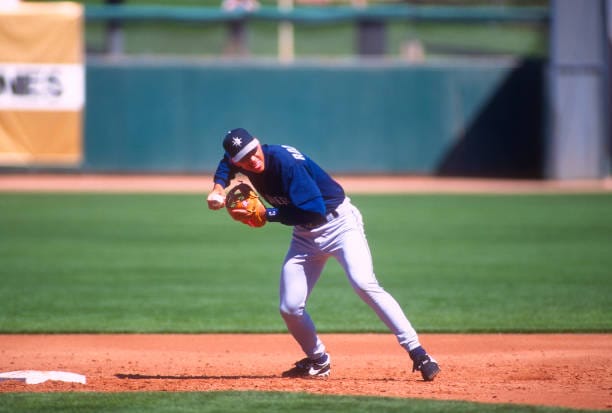
He just needed to be proficient at the plate and flash his glove. After all, wrote Jim Street in the Seattle Post-Intelligencer, “No one expects him to bat .300, hit 25 homers or drive in 90 runs. The Mariners are more interested in Rodriguez’s glove right now than his bat.”9
The outfield, with Ken Griffey Jr in center and Jay Buhner in right, had one pesky issue to resolve, the boogeyman in left field. It preoccupied sports writers and radio hosts. It lurked in the backfields of Peoria that spring, a Bermuda Triangle in which many took the field and few returned. Darren Bragg beat out the other contenders, which included Luis Polonia, Rich Amaral, and Alex Diaz, to join the scroll of Mariners left fielders.
Behind the plate, John Marzano was in camp as a non-roster invitee and the leading candidate to backup Dan Wilson. The Mariners had several promising catching prospects—Chris Widger, Raul Ibanez, and Jason Veritek—who needed to play every day in order to develop. Marzano had once been a promising prospect, but at 33 he was content with whatever job was available. “I don’t care how much I play” he said. “I’m happy to be a backup.”10
Going into spring, the starting rotation wasn’t totally set. The projected front end was Randy Johnson, Chris Bosio, and Sterling Hitchcock. Bob Wolcott was likely to get the fourth spot, and few names were thrown around for the fifth spot, including Rafael Carmona, Soloman Torres, Derek Lowe, Mike Butcher, Edwin Hurtado, and Paul Menhart. Injuries reared up during spring, as they tend to do. Bosio was nursing a sore knee and Johnson reported troubles with back spasms after a throwing session.
In the bullpen, Norm Charlton, Mike Jackson, and Bobby Ayala had guaranteed spots. However, among fans, Ayala was a question mark. Piniella was supportive of his beleaguered reliever, asserting his belief that Ayala would bounce back. “He pitched well last year, then had a really tough stretch.”11 Ayala was also eager to put his rough second half behind him, talking openly about his struggles, which he blamed on his mental state and allowing situations to spiral. “The main thing is to come out of camp with a clear head and get back to where I was in ‘94 and the first half of last year,” he earnestly told reporters.12 He was eager to redevelop his slider, a pitch he had thrown in the past, but discarded in 1994.
Unfortunately, during spring Ayala found himself dealing with some off-the-field issues that would only come to light once the season was underway.
In the meantime, the News Tribune ran this cursed headline:

Ultimately, Bosio’s knee troubles were too much to overcome and he opened the season on the injured list. The rotation for Opening Day was Johnson, Wolcott, Hitchcock, Menhart, and Hurtado. Bob Wells and Carmona earned spots in the bullpen with Charlton, Jackson, and Ayala.
The Mariners Will Be Televised
In another big offseason development, the Mariners announced more games than ever before would be available through broadcast and cable television. In total, 120 games were scheduled. 109 of those games were divided between KIRO-TV and Prime Sports Northwest. The remainder were national games on ESPN and Fox. The team for local broadcasts was Dave Niehaus, Rick Rizzs, and color commentator Ron Fairly, with Dave and Rick alternating their play-by-play duties on tv and radio each game.
The Mariners were also back with a new slate of commercials launching the slogan “You Gotta Love These Guys.” The Mariners were becoming known for their clever commercials and this year they were all about leaning into the personalities of their players and affection fans had developed for their guys
Opening Night
The Mariners opened the season on March 31 against the Chicago White Sox at the Kingdome. For all the worry about the on-field changes disrupting team chemistry and how they’d recreate the magic of 1995, the 1996 Mariners picked up right where they left off in a nationally televised game on ESPN’s Sunday Night Baseball.
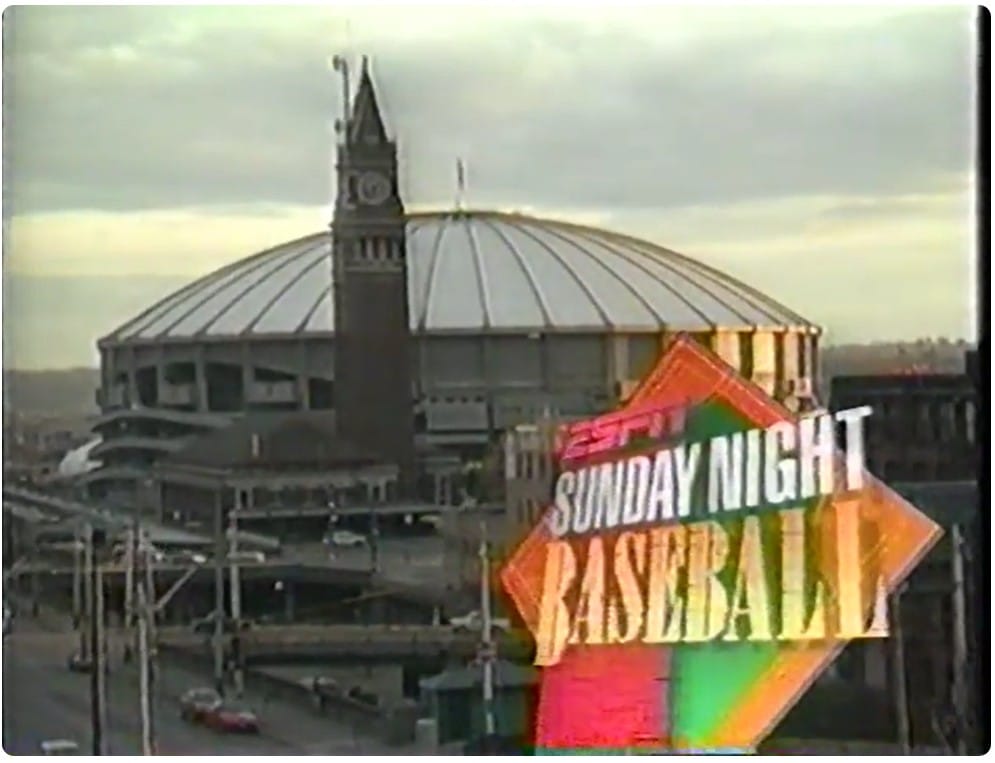
Randy Johnson got off to a rocky start, walking the leadoff batter before allowing a one-out two-run home run to Frank Thomas. But that’s all the damage the White Sox were able to do as Randy pitched 7 innings, striking out 14 while throwing 129 pitches.
The Mariners struck in the fifth when Darren Bragg, the last man added to the roster, hit a solo home run. They struggled offensively throughout the game; going into the ninth inning they were 0-8 with runners in scoring position. In the bottom of the ninth, Edgar Martinez hit a signature opposite field double to tie the game. If not for an unlucky bounce in the Kingdome outfield that sent the ball straight into right fielder Dave Martinez’s glove, it would have been the game winner. One batter later, Joey Cora raced for home on a passed ball only to be thrown out at the plate on a call that Piniella immediately leapt out of the dugout to argue.
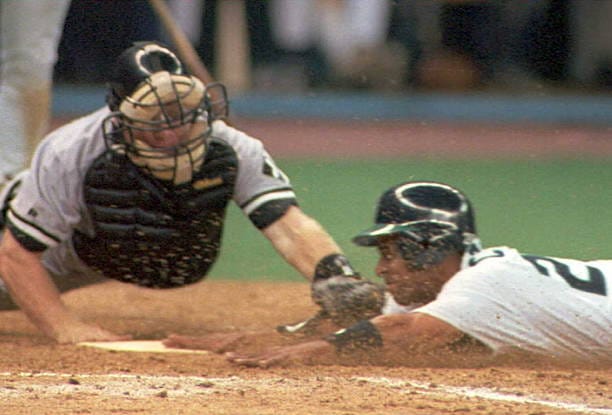
There was no score going into the bottom of the 12th inning. Doug Strange reached on a one-out error, followed by a Russ Davis double that moved Strange to third. With the bases loaded after an intentional walk to catcher Dan Wilson, Alex Rodriguez came to the plate.
Rodriguez, the ninth place hitter, was hitless in his first five at bats and was hyped on the adrenaline of the situation. He swung so hard at the second pitch he nearly lost his balance, using his bat to stop him from falling over. He fouled one off for a strike. Then, on the next pitch he struck the ball sharply to right center field. Strange scored and the Mariners won in extra innings to kick off 1996.
It felt like magic. It felt like 1995 all over again. Except this time, the Mariners already had a banner hanging in the outfield.
Notes
- LaRue, Larry. "Piniella hopes to build on success in coming season." The News Tribune, October 18, 1995: D11.
- Of course we know the process didn’t up being that straightforward, but for the moment, it was settled.
- Like all payroll numbers, this isn’t exact and different articles cited different numbers. These seemed to be the most common so I went with them, but whatever the “real” numbers are, you get the gist.
- Knight, Bill. "M's boost payroll, but at a cost." Seattle Post-Intelligencer, November 23, 1995: D1.
- LaRue, Larry. "M's set budget guidelines, limit means roster will change in 1996" The News Tribune, November 23, 1995: C1.
- Street, Jim, "M's deal Blowers to L.A., - Two minor leaguers satisfy budget move." Seattle Post-Intelligencer, November 30, 1995: F1.
- Finnigan, Bob. "Griffey talks of leaving: The Seattle Times, January 22, 1996: A1.
- Knight, Bill. "Big Bucks for Junior-M's Griffey now best-paid player in major leagues." Seattle Post-Intelligencer, February 1, 1996: A1.
- Street, Jim. "Rodriguez: 'It's Time'-M's shortstop prospect plans to start this year." Seattle Post-Intelligencer, February 22, 1996: D1.
- McGrath, John. "It's not heave, but it's close for John Marzano." The News Tribune, February 24, 1996: C1.
- LaRue, Larry. "Mariners '96: Arms aplenty as M's open camp." The News Tribune, February 15, 1996: D1.
- Street, Jim. "Ayala springing back from battered psyche-reliever adds slider to regain effectiveness." Seattle Post-Intelligencer, February 24, 1996: D1.
Comments ()